Blog

  • A Rationalist Case for Empathy

    Empathy is often conceptualised as an emotional or moral disposition, yet a rationalist approach suggests that it is an epistemic necessity rather than a subjective inclination. The intersubjective nature of human experience implies that empathy, rather than being a purely sentimental construct, emerges from the same principles that underpin language, social organization, and knowledge formation. This essay will explore the rationalist basis for empathy by demonstrating that rejecting it leads to synthetic inconsistency and that its necessity arises from the inherent absurdity of reality rather than from moral prescription.

    To establish the epistemic necessity of empathy, an understanding of intersubjectivity and synthetic concepts is required. Consider the libertarian notion of “aggression.” At a physical level, an action such as pointing a gun at an individual’s head is not inherently aggressive; however, it is considered as such due to the social consensus that threats constitute harm. The boundary of aggression—whether it begins at the moment of threat, the firing of a bullet, or the displacement of the first atom from a victim’s body—remains indeterminate. The classification of aggression, therefore, is not an objective fact but a collectively agreed-upon heuristic. More broadly, meaning itself is derived from intersubjective agreement rather than independent, objective criteria. This undermines the premise that ethical truths can be derived in isolation, as all synthetic moral constructs require collective recognition to be functional.

    If synthetic ethical constructs rely on intersubjectivity, then the rejection of empathy while upholding other intersubjective norms (such as rights, contracts, or personal autonomy) results in synthetic inconsistency. Empathy, in this context, is not merely a virtue but an epistemic mechanism that facilitates comprehension of other perspectives. The recognition of another’s agency, suffering, or intentions presupposes a capacity to engage with their experiences through an intersubjective framework. Thus, from a rationalist perspective, empathy is an indispensable element of knowledge acquisition rather than a mere moral sentiment.

    One might argue that even if empathy serves an epistemic function, it does not necessarily entail a moral obligation. Secular humanist responses to absurdity, such as those proposed by Camus, often posit that because existence lacks inherent meaning, one ought to create meaning through ethical action. However, this prescriptive leap is unjustified; there is no inherent necessity to impose meaning onto absurdity. Likewise, deriving ethical imperatives from intersubjectivity risks granting arbitrary moral authority to those who establish their own values upon unclear and inconsistent ethical foundations. Any ethical system that one imposes would necessarily be an intersubjective construct subject to the same limitations and contradictions.

  • All Ethics are Analytic

    Ethical systems, despite their apparent complexity and variation, can be modeled analytically. The set of possible moral actions in any given context can be represented as a discrete set of context-action pairs, where each pair corresponds to a conditional maxim governing behavior. Even if ethical decision-making appears continuous, it can be expressed as a function $f(x_1,x_2,…,x_n)$, demonstrating that ethical reasoning is reducible to a parametrizable and structured system.

    The claim that all ethics are analytical follows from the observation that ethical choices, whether grounded in deontological rules, virtue-based assessments, or existential commitments, can be mapped onto discrete decision frameworks. At any given time, an individual’s moral reasoning is confined to a finite set of value-driven maxims that determine their choices. The apparent fluidity of moral thought does not negate its discrete nature but rather reflects the complexity of its parameterization.

    Some may claim that ethical reasoning is inherently vague and resists analytic formulation. Virtue ethics, for instance, relies on context-sensitive judgment, and existentialist ethics prioritizes subjective experience over rigid principles. However, these ethical models remain reducible to structured sets. Virtue ethics, despite its reliance on practical wisdom $(\varphi)$, can be decomposed into a function $f(x)$ where $x$ represents relevant contextual inputs. Similarly, existentialist ethics, though emphasizing subjective choice, still operates within a bounded set of maxims at each moment, forming a discrete decision space.

    Others argue that overlapping moral maxims introduce irreducible vagueness, making formal analysis untenable. However, overlapping maxims can be described using $n^{th}$-dimensional Gaussian surfaces, which model the probability distribution of moral decisions across a given set of parameters. Alternatively, a discrete piecewise function can capture the segmentation of moral principles based on context. Thus, moral uncertainty does not imply non-analyticity; rather, it suggests a need for probabilistic or structured modeling.

    A further objection is that moral intuition and creativity transcend computational representation. Human moral reasoning appears to involve novel synthesis rather than simple function evaluation. However, the universal approximation theorem suggests that any continuous model of ethical reasoning can be approximated by a sufficiently complex function $f(x_1, x_2, …, x_n)$. Therefore, moral reasoning, even when it appears to evolve, operates within a computable space. New ethical insights or principles do not emerge ex nihilo but are instead refinements of existing parameterized structures.

    Reduction of Virtue Ethics and Care Ethics to Deontology

    Both virtue ethics and care ethics can be reduced to deontology using set operations. Define a set of context-action pairs $(C, A)$ where $C$ represents the contextual parameters and $A$ represents a possible action. A function $g: C \times A \to \{0,1\}$ defines the acceptability of an action, where $g(C, A) = 1$ indicates moral acceptability and $g(C, A) = 0$ indicates moral unacceptability.

    For virtue ethics, let $V$ be the set of virtues $\{v_1, v_2, …, v_n\}$, and let $h: C \to V$ map context to the virtue required in that situation. Then, we define acceptability as: $g(C, A) = 1 \iff A \in D(h(C))$ where $D(v)$ is the set of deontologically permissible actions corresponding to virtue $v$. This establishes a mapping from virtue-based assessments to deontological constraints.

    For care ethics, let $R$ be the set of relationships $\{r_1, r_2, …, r_m\}$, and let $k: C \to R$ map context to the relevant relationship. Define a function $p: R \to \mathcal{P}(A)$ mapping relationships to permissible actions. Then, the acceptability of an action is given by: $g(C, A) = 1 \iff A \in p(k(C))$ This formulation embeds care-based reasoning into a deontological framework where relationships determine the binding duties.

    The ethical decision surface can be modeled as an $n^{th}$-dimensional function $F: \mathbb{R}^n \to [0,1]$, where the probability of an action being permissible is given by a Gaussian function: $F(x_1, …, x_n) = \exp\left(-\sum_{i=1}^{n} \frac{(x_i – \mu_i)^2}{2 \sigma_i^2}\right)$ where $\mu_i$ represents the idealized virtue or relationship parameter, and $\sigma_i$ represents the variance in moral judgment. This allows for a smooth probabilistic transition between different ethical judgments while maintaining an analytically structured framework.

    If all ethical systems can be expressed analytically, this raises meta-ethical implications. It suggests that moral realism, wherein ethical truths exist as formalizable structures, may be more tenable than moral relativism. Alternatively, it supports constructivism, wherein ethical systems, though human-generated, remain reducible to structured sets of decision rules. In either case, ethical reasoning, while complex, is ultimately governed by definable, parameterized rules, affirming that all ethics are analytical.

  • What I Learned Installing Linux (Arch btw :3) on Zen 5 ASUS Notebook

    What I Learned Installing Linux (Arch btw :3) on Zen 5 ASUS Notebook

    Apple Silicon MacBooks have been almost been drug-like for me over the last few years, I love how everything just works, the POSIX shell and Homebrew. Yet a thought always lingered over my head, I shouldn’t trust their proprietary software for so long and risk my metadata being logged. The time has finally come for me to part myself from Apple. Also, sorry die hard Linux fans, but I’m not going to rely on vintage hardware like ThinkPads and third-party GPU clusters to train and run my models.

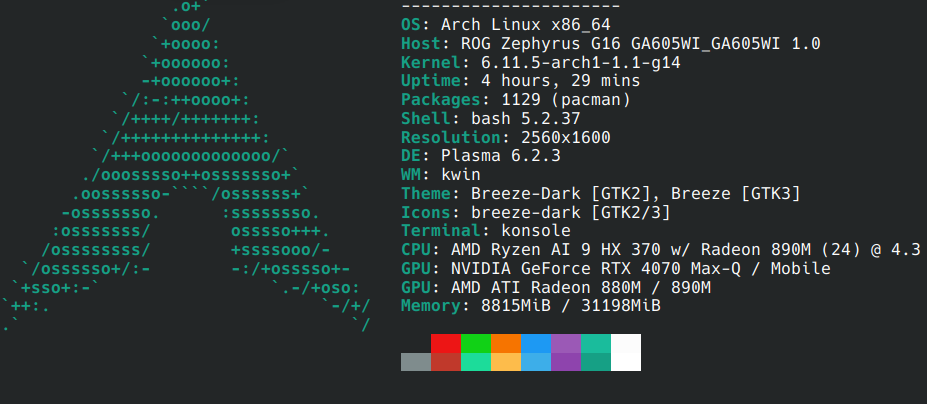
    I wanted something stylish and MacBook-like, so I decided to purchase the new ASUS ROG Zephyrus G16 (GA605WI) with HX370 and RTX4070, which I must add, is insanely overpriced at the moment, at least in Australia. I’d wait a few months before buying this computer, especially since NVidia Blackwell (5000 series) GPUs are coming soon.

    Installing Arch & ASUS Packages

    This is pretty self explanatory, and if you have any trouble with this part, I’d advise you to “read the f#**ing manual.” I decided to install NVidia’s proprietary drivers, I advise to you to not do this right now!!!

    After I installed Arch, I proceeded to install the recommended utilities as well as the custom kernel at:
    https://asus-linux.org/guides/arch-guide/

    The ASUS G14 kernel requires a NVidia driver rebuild

    After installing the kernel from asus-linux.org, I immediately faced issues with sddm. The log read something along the lines of: Failed to read display number from pipe.

    To resolve this issue, I completely uninstalled all nvidia drivers, reinstalled nvidia-dkms drivers and rebuilt the initramfs:

    sudo pacman -Rns nvidia nvidia-utils nvidia-settings
    sudo pacman -S nvidia-dkms
    
    sudo mkinitcpio -P
    sudo reboot

    And it worked! In hindsight, I should’ve installed drivers after I installed the kernel but I digress.

    The system refuses to use iGPU by default (and drains battery)

    No matter what I tried, I could not manage to get my system to default to using integrated graphics (Radeon 890M). Here’s a list of some of the things I tried:

    1. Remove all references to the NVidia GPU from my X11 configuration at /etc/X11/xorg.conf
    2. Blacklist NVidia drivers. This worked, but I could not selectively switch to my dGPU for Gaming, 3D or AI workflows.
    3. Using switching tools such as switcherooctl, optimus-manager and bumblebee.

    Note: The PCI addresses from lspci are in hexidecimal, whereas the entries in xorg.conf are in decimal. This means that an address of 64:00.0 corresponds to a BusID of PCI:100:0:0 in xorg.conf.

    After a bit of tinkering, I discovered that the issue was that the iGPU was card 1 and dGPU was card 0, the card orders were inverted. I added the following lines to /etc/environment, rebooted and my problems were solved:

    DRI_PRIME=1
    MESA_VK_DEVICE_SELECT=1
    VK_ICD_FILENAMES=/usr/share/vulkan/icd.d/radeon_icd.x86_64.json
    KWIN_DRM_DEVICES=/dev/dri/card1:/dev/dri/card0
    

    To run certain programs using the dGPU

    Just run them with the following environment variables:

    DRI_PRIME=0 MESA_VK_DEVICE_SELECT=0 VK_ICD_FILENAMES=/usr/share/vulkan/icd.d/nvidia_icd.json __GLX_VENDOR_LIBRARY_NAME=nvidia

    Out of the above environment variables, I found VK_ICD_FILENAMES=/usr/share/vulkan/icd.d/nvidia_icd.json to be the most important one.

  • Sartre’s Justification of Existentialism

    Existentialism is a philosophical movement which focuses on topics such as human freedom and the search for meaning in an indifferent universe. Jean-Paul Sartre, one of its central figures in his 1945 lecture Existentialism is a Humanism, advocates a worldview in which human existence (our choices and our actions) are central to how a human is defined, rather than some predefined human nature. Sartre’s existentialism led to an idea of freedom in which we decide how we are defined and take responsibility for our actions. This essay will explore the rationales for, and implications of Sartre’s existentialist theory that “existence precedes essence” and how it relates to the way in which we should live.

    To understand what Sartre means by “existence precedes essence”, an understanding of how “existence” and “essence”, and the various ways in which they are defined is required. In Existentialism as a Humanism, Sartre assumed the existence of humans to be a self-evident, conscious reality, without rigorous proof, stating that “man first of all exists [and] encounters himself”. Essence, on the other hand, is classically defined as a set of conditional qualifiers that an object or concept must possess to be considered that concept or object. Consider the following. Let us define the essence of water as: “a molecule”, “one oxygen atom” and “two hydrogen atoms”. From this prescriptive definition, we can infer that non-molecular objects, or a molecule with an incorrect number of oxygen or hydrogen atoms is essentially not “water”. By contraposition, we can infer that if an object is essentially “water”, then this object must satisfy the molecular properties as previously stated. To put simply, an essence of an object or concept are sufficient conditions for its existence. Under this definition, essence precedes existence since objects or concepts are contingent, being instantiated by the satisfaction of their essential elements (conditional qualifiers). In general, let $X$ be some concept or object and $Es(X) = \{e_0, e_1, …, e_n\}$, be the set of essential elements of $X$ ($X$’s essence). Then for some instance of $X$:

    $[\forall e \in Es(X), e] \implies X$

    In practice however, the assignment of discrete essential elements is often normative, arbitrary or otherwise unclear. This sentiment was echoed by William of Ockham in his 1323 text Summa Logicae. Ockham maintained that “[universals are] not something real that exists in a subject …but that it has a being only as a thought-object in the mind.” Although Sartre holds that non-human objects including “paper [knives]” do have discrete essences, these are products of human intention and design. On the other hand, Sartre argues humans, unlike other objects, are “thrown into this world” without inherent qualities, meaning or purpose. This absence of a predefined essence implies that human beings are responsible for defining their own essence through their choices and actions. Under this definition, existence precedes essence since the essential elements (or human nature) are contingent, being instantiated by the existence of the human. In general, let $H$ be a human and $Es(H)$ be the set of essential elements of $H$ ($H$’s nature). Then for some instance of $H$:

    $H \implies [\forall e \in Es(H), e]$

    In Existentialism is a Humanism, Sartre presented 3 main arguments to support his existentialism – that “existence precedes essence” in humans. Firstly, he assumes the “atheistic” premise that God does not exist. From this, he deduced that since God does not exist, “there is at least one [necessary] being whose existence comes before its essence”, with that being humans. Parallels can be drawn between this and Aquinas’ contingency argument, which states that all contingent beings must trace back to some necessary being, to avoid infinite recursion. Sartre argues that without a divine creator to prescribe a universal human nature, humans must define themselves through their choices and actions, thus, assuming the position of the necessary existence that bestows essences upon contingent existences, for example paper knives. If humans too, were a contingent existence whose essence precedes existence and there is no God, then it follows that there would exist no necessary existence to provide a finite closure, inducing an infinite regress and undermining the consistency of the atheistic premise. This led Sartre to argue that existentialism is essential for a coherent atheistic worldview. Secondly, he assumes the Cartesian theory of the Cogito, arguing that “every theory [beginning] with man, outside of [the] moment of self-attainment”, is dubious, since action is directly tied to the Cogito itself. According to Sartre, outside of action, all else becomes probabilistic. This means only through intentional acts can one affirm their existence and, by extension, their essence, whereas theoretical assumptions about human nature and the essences of contingent existences, without such actions are unreliable.

  • Theorem of Ethical Rationalism

    Let $E$ be a formal ethical system with propositions $E_P$, conclusions $E_C$ such that:

    $$
    \forall c \in E_C, \exists P \subseteq E_P : (\prod_{i=0}^{|P|} p_i \vdash c), p_i \in P
    $$
    Where $\prod_{i=0}^{|P|} p_i \equiv p_1 \land p_2 \land … \land p_{|P|}$

    Let $A_U$ be the universal action space, the set of all possible actions, $I(E) \Leftrightarrow E$ is an inconsistent ethical system, $G(a) \Leftrightarrow a$ is a good action under $E$ and $X(a) \Leftrightarrow a$ is an evil action under $E$.

    $$
    \begin{align}
    &\text{Lemma } 1.1) \quad \left( \exists p \in E_P : E_P \vdash (p \land \neg p) \right) \Rightarrow I(E) \\
    &\text{Lemma } 1.2) \quad I(E) \Rightarrow G(a) \in E_C, \forall a \in A_U \\
    &\text{Lemma } 1.3) \quad \left( \exists a \in A_U : X(a) \right) \\
    &\text{Lemma } 1.4) \quad I(E) \Rightarrow \left( G(a) \in E_C, \forall a \in A_U \right) \land \left( \exists a \in A_U : X(a) \right) \dashv (1.2 \land 1.3) \\
    &\text{Lemma } 1.5) \quad \text{JustifiesEvil}(E) \Leftrightarrow (\exists a \in A_U : E(a) \land G(a) \in E_C) \\
    &\text{Therefore}) \quad I(E) \Rightarrow \text{JustifiesEvil}(E) \dashv (1.4 \land 1.5)
    \end{align}
    $$

    It has hence been shown that an inconsistent ethical system necessarily justifies evil.

  • Iris Profile Picture

    Iris Profile Picture

    PfP for @error_vittra on Instagram